
Kamala’s Economic Gamble
Harris Gambles an Economy
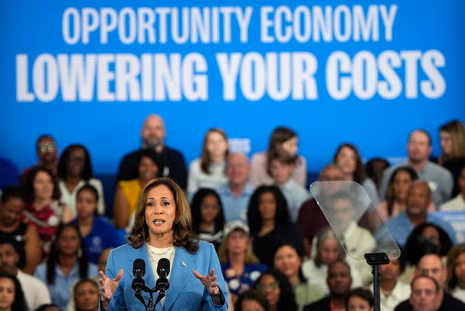
Kamala Harris, Democrat presidential nominee and frontrunner in the most recent polls for the 2024 election, has a lot to do and hardly any time. With 2 months left until Americans go place their ballots, she needs to outline and prove herself capable of executing her main campaign promises, demonstrating to voters that her relative disadvantage in political experience would not affect her presidency. But she can’t zero in on just any hot-button topics. Harris will need to be strategic in choosing what parts of her campaign to promote and what specific proposals she’ll sell as the best solutions to America’s problems, particularly so when it comes to the economy. If Harris doesn’t convey her ability to take control on market issues rather than just social ones, she may lose the trust of one too many moderate voters.
Kamala Harris can’t let economic policy cost her the election. When she gambles on it with controversial policy proposals and a lack of foundational support, however, it may very well do that.
What’s up with the economy?
As with any election cycle, the economy will play a crucial role this November in two main ways: First, by setting the economic conditions under which Americans will vote and secondly, by allowing Americans to decide whose proposals to fix it are more likely to succeed. For example, the current greatest concerns among the US are alarming inflation rates, a potential bubble in the stock market, and the federal budget deficit, which has hardly been reduced under the Biden administration. First, voters will try to ascribe blame for these economic conditions, often doing so uneducated. In this case, Americans are most likely to tie inflation and these other contemporary issues to Biden. But beyond this, voters will take to their TVs in order to find out how these problems will be resolved.
This is where it gets complicated for Harris: she needs to unveil an economic masterplan capable of “fixing” the US economy, or at least, convincing America it will work. Worse, her rhetoric will somehow have to exceed that of candidate Donald Trump, a billionaire and an ex-president credited for a prosperous US economy. This is a lot to ask and with less than a month leading up to election day, it gives Harris scarce time to flesh out her proposals.
Additionally, Harris will need to save face for the Democratic party with her new policies, especially considering that Democrats are suddenly being seen as “weak” on the economy. Biden’s grand “Bidenomics” scheme was attributed to heightened inflation and national debt by Republicans. After years-long trouble of negotiating with various unions, Democrats are seen as neither powerful nor down-to-earth. With Harris inheriting these burdens, she’s going to have enormous expectations put on her. As a result, the plan to “fix” the economy that she puts on the table will be all-telling to voters.
If Harris can’t do it, America has a backup plan: Trump. Whatever her campaign ends up rolling with, there will still be the possibility voters hesitate to accept it. The consequence for that is a vote for Trump and another jab at Harris’s reputation.
What does Harris propose?
With no time to lose in preparation for election day, Harris already presented her proposals for the country weeks ago. This has left plenty of time for America to properly consider what she’s offering, but a clear attitude has been established by now. To understand it, one must first understand Harris’s points.
At the top of her list of renovations, Harris is planning to redefine taxes, at least for certain groups. Families, small business owners, and low-income US citizens would all be eligible for major tax breaks, while large corporations and individuals profiting off of unrealized capital gains (i.e. when the value of an unsold investment increased) would face beefed-up tax rates. When using surface-level analysis, this proposal sounds perfectly in-line with Democrat’s past policies, and appears to be a relatively simple way to bridge the income gap in the US. However, it’s not so simple.
Expanding tax credits for the country will come at a formidable cost, although it isn’t one that’s likely to hurt Harris in the short term because of Trump’s even more expensive tax plan. Ironically, the problem is that all of these policies are truly too good to be true. A potential $50,000 tax benefit for small businesses, greater relief for low- and middle-class citizens, and financial help for families would affect upwards of 100 million Americans, but it’s also inefficient for the millions of dollars that would be poured into sponsoring it. The Tax Policy Center reported that something both Harris and Trump have been guilty of this summer is trying to hyper-target subsidies for increasingly niche groups of people. Essentially, who gets a tax break is more likely to be determined by how valuable of a voter group they are in, i.e. an owner of a small business or someone struggling with a disability. Then, the campaigns gauge how they would react to benefits and if they believe it’s worth it, they announce their new proposals for tax breaks. When subsidies are so hyper-targeted and specific that they don’t maximize their effectiveness instead, economists get suspicious. Then, Democrats may follow in their footsteps.
Harris’s tax benefits are even extending to the housing industry. Although it doesn’t help her case on the overly specific and populistic subsidies, Harris has promised a $25,000 credit for new homebuyers. This, however, has unique perks and consequences other tax breaks don’t. The last time such a credit was enacted, during a nationwide housing crisis, the market was able to stabilize and demand recovered in a matter of months. Of course, that also made it incredibly popular. Now, circumstances are vastly different and the proposal would likely just end up worsening inflation and decreasing supply of houses. According to some economists, Harris has to time her policies right and couple them with additional measures on rent caps, older housing stock, and more, if they are to potentially work. If done right, it would create an estimated 3 million new homes in 4 years.
The final pillar of Harris’s economic agenda is healthcare. Harris has taken a major risk by decoupling herself from plans like Medicare For All, sparking outrage from Democrat leaders. Medicare for All, a plan to establish universal healthcare coverage and override the current system of public/private providers, is and has been a major talking point for Democrats. Most notably, Senator Bernie Sanders supported and even reintroduced the plan in 2023. With him, so have millions of Democrat Americans. Rather than joining them, Harris has instead focused her healthcare agenda on canceling medical debt, providing tax credits, negotiating lower prices (as was recently done with drugs sponsored by Medicare), and continuing federal probes into insurance companies for transparency sake.
Harris has brought all of these ideas and more to the table and yet, she’s received mixed results. It’s now an undeniable fact that her policies on social issues will be the core of her campaign rather than her takes on the economy. This doesn’t necessarily mean that the public’s current response to her won’t change in the future. Nor is it to say that Americans see every part of Harris’s proposals as a failure, but critics exist and have been vocal about it.
Why the criticism?
Based on the many progressive policies Harris has endorsed for her proposed economic policy, it’d seem safe to say that her stance is relatively aligned with that of other Democrats. At least, that’s what many election analysts believed before Harris fully unveiled her plan to beat Trump on the economy. At this point, Democrats haven’t yet reached a consensus on her policies and the party is divided on whether or not to stand alongside Harris’s promises.
First to consider is the response to Harris’s wanted tax credits, because of how the proposal has resonated with some and been ardently opposed by many others, including big-name Democrats. For example, billionaire and public figure Mark Cuban, also known for being a staunch supporter and mega donor for the blue, recently denounced Harris’s tax credits, claiming that they would even kill the economy. This problem is compounded when taking into context the dozens of swing-seat Democrat congressmen and women that haven’t even endorsed Harris as a nominee.
Needless to say, Harris is being accused of a lot more than just playing with the stock market. Other sources of opposition have been the so-called “populism” behind her promises. Tax credits that are expected to reach 100 million Americans can’t just be paid for by upping the taxes of the wealthy; they require the federal government to add to its deficit. In other words, the tax credit plan is being seen as a ploy that is distributing money to the hands of random Americans not because they need it, but because of the potential appeal. In some cases, the tax breaks are laser-focused on boosting specific voter demographics rather than groups in need. Harris’s housing policies aren’t exempt from these allegations, of course. Promising to build over 3 million new homes despite a subsiding housing crisis isn’t the best look.
Still, some of Harris’s economic plans even overlap with her social agenda, meaning if one fails, it will inevitably drag down her other plans. To understand this, we have to look into Harris’s position on healthcare. Although like many of her coworkers, she has endorsed the Affordable Care Act, her distance from the Medicare for All plan may be detrimental. With more than 60 major unions fighting for the Medicare for All plan, the preference of 77% of Democrat voters, and disproportionate support from crucial voter demographics, Harris is dropping a point that an enormous part of her voter base has been counting on. Thankfully for her, this likely won’t be enough to push them to vote for Trump, but for softer-leaning Democrats and moderates, it just may be.
How’s Trump doing?
In the face of growing criticism for Harris’s economic plans, the Trump campaign has been given a golden opportunity: by capitalizing on her relative lack of political experience and already rough track record on the market, they could recapture some of the momentum they’ve lost in the past few months. Considering the slight decline in support for Trump and the fact that (early) voting has even begun in some states, this is more than just a “smart” move. It may be the only path forward for a struggling Trump.
First, Americans will compare what they see on Harris’s end with both Trump’s current ambitions, but also his past policies. Starting with his stance on taxation, Trump isn’t much different in his general proposals for tax credits. The difference becomes more obvious when Americans contrast what groups Trump is targeting compared to Harris, mainly in that his policies are more geared towards corporations and the wealthiest in a direction opposite of Harris. For example, corporate taxes would be cut as much as 15% under Trump, old tax cut distributions that favored the rich would be brought back, and taxes on social welfare programs, namely Social Security, would be cut. This establishes Trump as a candidate representing the interests of the mega-wealthy, which actually boosts Harris’s ambitions to connect with the people. If she stays insistent on her promise to offer such extensive tax credits, the advantage on taxes would go straight to her.
Naturally, if her proposed tax plans were really perceived as so genial, then the presidential race would be as good as hers. However, there are still countless barriers to Harris’s economic policy gaining the leg it needs over Trump. First, although both candidates have been accused of reiterating populist talking points for the sake of earning as much of the vote as possible, only Harris has been slandered for it on the basis of her economic policies. Trump’s takes on the economy thus far have never revolved around less taxes for the ordinary people. Rather, Trump has framed his policies on US economic dominance on a global scale and the macro of his actions for the economy at home. Job growth, record low unemployment, and to boost, manageable inflation were what he boasted in 2020, immediately after his first term in office. Next to such grand visions, Harris’s proposals are being viewed as short-term relief, unsustainable in the long-run and insignificant to the larger US economy. Voters can’t know for sure if this is true or not, but the impression they’ve currently created is more important for the election.
Secondly, Trump has the advantage of experience. Not only has he had his 4 years in office from 2016-2020, but America knows very well about his years before office. As a highly successful businessman and billionaire, the name “Donald J. Trump” has been in the news long before 2016. According to a Gallup poll from December 1988, Trump was once the tenth most admired man in America. As a result, older generations are trusting the face of the Trump enterprise with something of great power: the reins to the US economy. In contrast, Harris has hardly had time to establish herself as a credible candidate, but also a capable leader in economics. With her being given a mere 3 months to prepare and present an entire campaign for the presidency, she’s already under a tight schedule. Having lost the advantage of national recognition, her situation only gets worse.
When it comes to social issues and more complex issues that will be on the ballot, it’s difficult to make a clear comparison between the two parties, however. Voters will choose what to support based on their own affiliation and values, which candidates’ proposals on social issues will try to pander to rather than being geared towards moderates or the unaffiliated. Evidently, the economy is much more of a gray zone: the average voter’s preferences aren’t set in stone and that leaves plenty of leeway for either party to take the lead.
What’s next for Harris?
At the end of the day, the inner-party criticism that Harris has amassed rules above all else. A divided Democrat party is the last thing her campaign needs and it puts her on thin ice: although the majority of unsure Democrats are refusing to vote for Trump, a mistake from Harris may reveal a turning point. It all depends how many core issues voters will sacrifice until they no longer feel it’s worth voting for the blue.
Still, Harris has less than a month ahead of her from today. Although it was believed that that would not be enough time for Harris to gain traction, it’s clear now that her campaign is following a decent pace. Harris’ critics will likely struggle to rack up enough support, especially if they think they can make a difference by November. Economic policy isn’t going to make or break criticism, and changes in Harris’s approach on the economy won’t suddenly quash all critiques directed towards her.
To take on the highest executive position in the United States, a woman has to be resilient. Although Harris’s economic policy was initially seen as a weakness, a prick stuck deep into the side of her campaign, it may now be a token of Harris’s perseverance. Just how significant will this be? To answer this, we can only wait until November.
Works Referenced
Emerson, Jakob. “Kamala Harris and Medicare for All: 5 Notes.” Beckershospitalreview.com, 19 Aug. 2024, http://www.beckershospitalreview.com/strategy/kamala-harris-and-medicare-for-all-5-notes.html.
Gleckman, Howard. “Harris and Trump Would Create Hyper-Narrow Targeted Tax Breaks.” Tax Policy Center, 9 Sept. 2024, http://www.taxpolicycenter.org/taxvox/harris-and-trump-would-create-hyper-narrow-targeted-tax-breaks. Accessed 16 Oct. 2024.
Ioanes, Ellen. “Kamala Harris’s and Donald Trump’s Wildly Different Tax Plans, Explained.” Vox, Vox, 10 Sept. 2024, http://www.vox.com/2024-elections/370753/taxes-debate-trump-harris-irs-tariffs-child-tax-credit.
“Medicare-For-All: Support among Adults by Party U.S. 2020 | Statista.” Statista, 2020, http://www.statista.com/statistics/1079553/share-us-adults-who-support-medicare-for-all-party/.
“NEWS: Sanders Introduces Medicare for All with 14 Colleagues in the Senate» Senator Bernie Sanders.” Senator Bernie Sanders, 12 May 2022, http://www.sanders.senate.gov/press-releases/news-sanders-introduces-medicare-for-all-with-14-colleagues-in-the-senate/.
Peck, Emily. “What Happens When You Give People Money to Buy Houses.” Axios, 19 Aug. 2024, http://www.axios.com/2024/08/19/first-time-home-buyer-tax-credit-kamala-harris. Accessed 16 Oct. 2024.
Gallup, George. The Gallup Poll : Public Opinion 1989. Wilmington, Del., Scholarly Resources Inc, 1990.
Smart, Tim. “Trump’s Economic Plans Will Explode the National Debt, Though Harris Will Also Add to the Tally.” US News & World Report, U.S. News & World Report, 2024, http://www.usnews.com/news/economy/articles/2024-10-16/trumps-economic-plans-will-explode-the-national-debt-though-harris-will-also-add-to-the-tally. Accessed 18 Oct. 2024.
Saul, Derek. “Harris vs. Trump on the Economy: Trump Now Holds Just Slim Lead on Issue in Latest Poll.” Forbes, 23 Sept. 2024, http://www.forbes.com/sites/dereksaul/2024/09/20/harris-vs-trump-on-the-economy-trump-now-holds-just-slim-lead-on-issue-in-latest-poll/.
Horton, Jake. “Is US Economy Better Now than under Trump?” Bbc.com, BBC News, 2 Sept. 2024, http://www.bbc.com/news/articles/c8xl5vnlzpwo.
Arnold, Jeff. “How Do Donald Trump, Kamala Harris Differ on the Economy?” NewsNation, NewsNation, 27 Aug. 2024, http://www.newsnationnow.com/politics/2024-election/donald-trump-kamala-harris-economy-inflation-policy/.